History
Brahmaswam Madham, Thrissur – Rigveda Pathasala and Vedic Research Centre
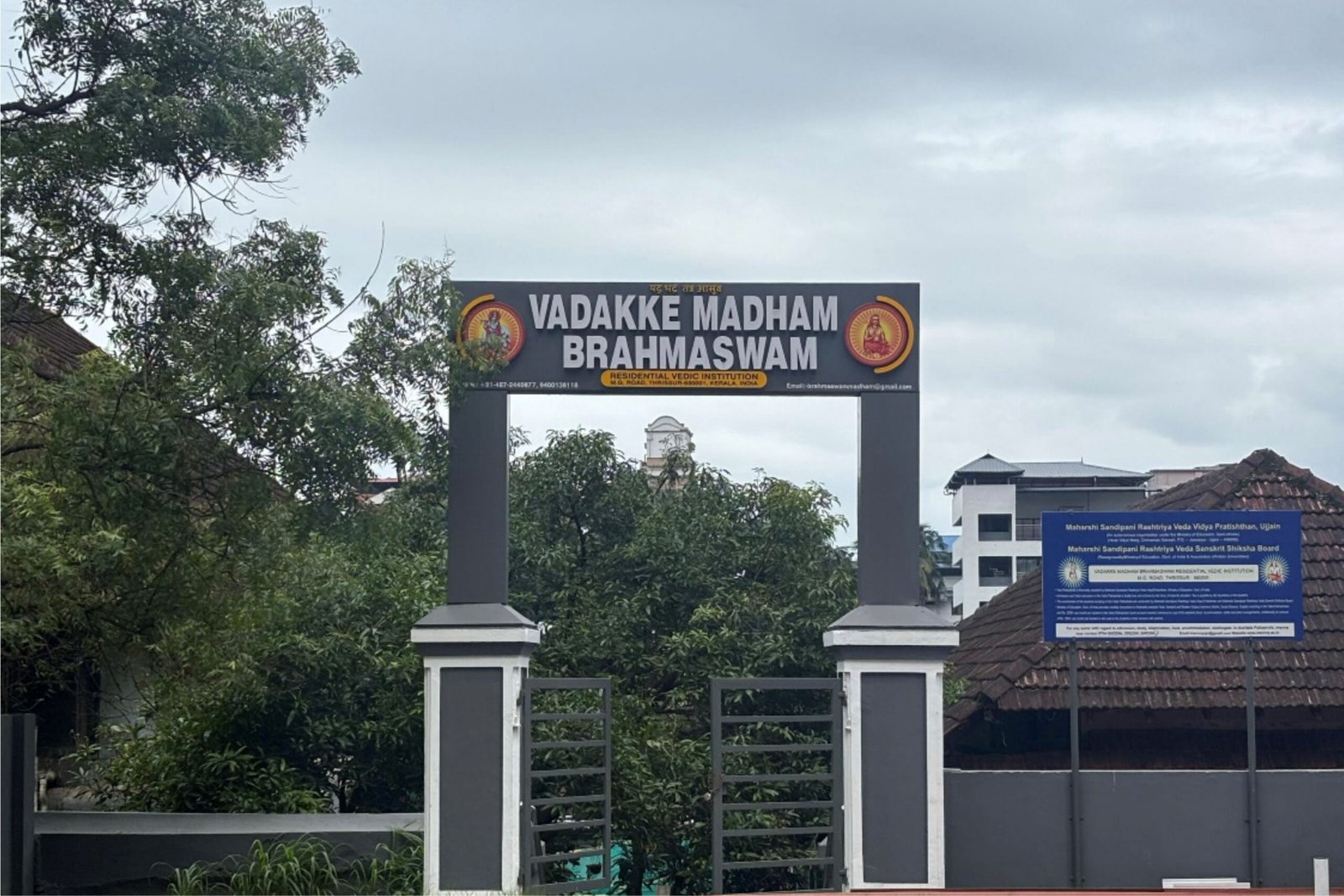
Vadakke Madham Brahmaswam (VMB) Thrissur, famous as Brahmaswam Madham, is a traditional Rigveda Pathasala in Kerala which has a history of centuries. Recently, for the past more than ten years, a Vedic Research Centre (VRC) is also established as part of VMB for the dissemination of Vedic knowledge among the public regularly conducting workshops, seminars, endowment lectures, colloquiums, Vidvatsabhas and the like related to the topics connected with Vedic knowledge and Indian intellectual traditions. Situated in the heart of the city of Thrissur, VMB together with VRC has contributed / is contributing much to the Vedic tradition and to the Indian culture in the present time.
500+
Years of Legacy & Tradition
Four Madhams of Sankara tradition in Thrissur
According to tradition, Sree Sankara was born at Kalady in Kerala and had his Samadhi in Thrissur. There is a particular place of worship in the famous Vadakkumnnatha Temple at Thrissur even now where Sankara is believed to have attained Moksha from worldly bondage. Sankara has already established four Sannyasi Madhams at four corners of India as part of his life mission for the promotion and propagation of Advaitha doctrines and his four disciples were given charge of each of them. Accordingly, it is believed that Suresvara became the head of Sringeri Madham in Karnataka in the South, Padmapada at Puri (Govardhana Madham) in the east, Hastamalaka of Dvaraka in the West (Sarada Madham) and Todakacharya at Badari in the North (Jyotir Madham). In these four Madhams, the lineage of Sankara’s Advaitha doctrine continues even now. The Sannyasis of Sringeri Madham have the title Saraswathi, Puri and Bharati and the Brahmacharis there have the name Chaithanya. The Sannyasis of Puri have the title Vana and Aranya and the Brahmacharis there are called Prakasa. The Sannyasis of Dvaraka have the title Teertham and Ashramam and the Brahmacharis there are called Swaroopam. The Sannyasis of Badari have the title Giri, Parvatam and Sagaram and the Brahmacharis there are called Ananda.
It is also believed that the four Madhams followed the Advaitha ideals of the four Mahavakyas of the Upanishads, Sringeri that of ‘Aham Brahmasmi’ (of Kadhopanishad of Yajurveda), Puri that of ‘Prajnanam Brahma’ (of Aitareyopanishad of Rigveda), Dvaraka that of ‘Tattvamasi’ (of Chandogyopanishad of Samaveda) and Badari that of ‘Ayamatma Brahma’ (of Manḍookyopanishad of Atharvaveda).
Swamiyar Madhams at Thrissur in Kerala
Tradition also says that at the time of Guru Sankaracharya, one of the kings of Mahodayapuram, Rajasekhara, ruled over Kerala. The king had great respect to Sankaracharya and so, after his Mahasamadhi, requested his four disciples to establish four Sannyasi Madhams in Kerala and to bless the land propagating Advaitha accepting the leadership of the Madhams. Accordingly, the four disciples established the four Sannyasi Madhams in a complex in Thrissur on the eastern banks of the big pond in the heart of the city which is called Padinjare Chira. ‘Chira’ means ‘big pond’ and ‘Padinjaru’ means ‘in the west’. The big pond got the name as it is situated in the western part of the city. This big pond in the same name and the Madhams on the eastern banks of it in a complex are even now there in Thrissur city as a monument of our eternal cultural tradition.
Another legend also is popular among the people regarding the institution of the four Madhams. According to it, Sankara, after returning to Kerala almost completing his life mission, during his last days, himself requested his four disciples to establish the four Madhams for the purpose mentioned above. Guru established four Madhams in the four corners of the country for the propagation of Advaitha doctrine. He wished such a mission to be executed in his place of birth, Kerala, which he entrusted with his four disciples and, accordingly, they established the four Madhams in Thrissur. There are no historical or inscriptional evidences for such conclusions. But myths and local traditions existing even now support these facts and the Madhams are there in Thrissur as a proof of all these.
The complex of Svamiyar Madhams is very near to the Vadakkunnatha temple also. The four Madhams are named according to the direction where they are in the same complex, Vadakke Madham (Vadakku = North), Naduvil Madham (Natuvil = in the middle), Idayil Madham (Idayil = in between) and Tekke Madham (Tekku= South). The lineage of the four Madhams are attributed to the four disciples of Sankara, Hastamalaka that of Vadakke Madham, Suresvara that of Naduvil Madham, Todaka that of Idayil Madham and Padmapada that of Tekke Madham. There is difference of opinion, according to some traditions, regarding the relation of Todaka with Idayil Madham and Hastamalaka with Vadakke Madham. The belief that Todaka was the head of Vadakke Madham and Hastamalaka that of Idayil Madham also exists. These four Madhams, believed to have started at about 9th century CE, except Idayil Madham, continue to exist in the complex of the buildings on the banks of the pond in the heart of the Thrissur city, even now. Idayil Madham, later was shifted to Trikkaikkadd Madham at Tanur near Tirunavaya in the Malappuram Dist, Kerala, due to some historical and cultural reasons, not known correctly. Tradition also says that Edayil Madham was merged to Tekke Madham. No historical evidence for these conclusions are available. Now only three Madhams are there in the complex.
It is said that Vadakke Madham also ceased to be a Sannyasi Madham in another context, the institution being converted to a Rigveda Pathasala, the legends related to which are given in the following paragraphs. Tradition also says that Edaneer Madham, near Kasaragode in Kerala retains the Sannyasa lineage of Vadakke Madham.
In the Sreesankaracharyacharitam written by Govindanatha, there is clear reference to the point that Sankara, during his last days, came to Kerala, his native place-
मानितोऽथ सदा सद्भिः वाग्देव्या च सुविस्मयम् ।
महानुभावः स्वैः शिष्यैः प्रतस्थे शङ्करस्ततः।।
क्षेत्राणि परितो पुण्यतीर्थानि च निषेव्य सः।
क्रमेण शिष्यसंयुक्तो वृषाचलमवाप्तवान् ।।
(Canto IX, Slokas 17,18)
Vrishachala mentioned here is identified as Thrissur by scholars and historians.
Vadakke Madham converted to Rigveda Pathasala
All these three Madhams, Vadakku, Naduvil and Tekku, had the lineage of Sannyasis of Namboothiris of Kerala based on Sankara tradition, the Sannyasa methods of which have many differences compared to that of other similar ones.
But, again according to tradition, the lineage of Sannyasa was broken in Vadakke Madham. One Svamiyar of the Madham decided to give Sannyasa to a Namboothiri boy who was the only child of the couples. Mother was deeply moved by this, not able to bear her sweet boy being dedicated to the Sannyasa order. She cursed the Sannyasi, the head of the Madha who decided to give Sannyasa to her son. The curse was not to have the lineage of Sannyasis in Vadakke Madham any more. It is believed that this happened at about four hundred or five hundred years ago. Anyhow, the curse of the Brahmana mother had its effect. Somehow, the Sannyasa lineage of Vadakke Madham did not continue. It is said that the last Sannyasi of the Madha decided to dedicate the Madha to the Rigveda Namboothiris of Kerala headed by their leader Cannaliyod Vadhyan. Another tradition also is in vogue regarding the Vadakke Madham getting the status of Rigveda Pathasala. According to that, one Sannyasi of Vadakke Madham who became the head there was a Brahmana from Karnataka who were called Embranthiris in Kerala. They were not considered as having the status of Brahmana as that of the Namboothiris of Kerala. Due to this Namboothiris began to avoid him honoring in the rituals and social gatherings. Usually Sannyasis from all these Madhams were held in high esteem with all respect in all Srauta and Smarta rituals. This disgrace began to haunt the Sannyasi and he, at last, left the Vadakke Madham to Himalayas for getting peace of mind and solace, dedicating the Madham to the Rigveda Namboothiris of Kerala headed by the Vadhyan. Tradition also says that on the way, when he reached the boarders of Karnataka, he was stopped by the devotees requesting him to stay there blessing them. They also assured all support to build a Madha there for him. It is said that the Edaneer Madha near Kasaragod came into existance in this way. Anyhow, the Sannyasis of Edaneer Madham even now believe that their lineage is from Vadakke Madham, Thrissur. No recorded history, except tradition, exists as support of these informations also. Anyhow, from that time onwards, Vadakke Madham began to function as the Rigveda Pathasala of Keraka, the only Vedic institution that has such a long history as Vedapadhasala in Kerala. The other two Svamiyar Madhams of Thrissur, Naduvil and Tekke, continue to exist there in Thrissur with the lineage of Namboothiri Sannyasi tradition of Sankaraorder.
Origin of Tirunavaya Brahmaswan Matham
Earlier, especially in the medieval ages of CE and after that, every Namboothiri household was like a Gurukula where there was arrangements for Vedic learning. Samhita of Rigveda and higher modes of chanting of Rigveda like Pada, Krama, Jada and Ratha were also taught in houses which were like Gurukulams themselves. When Thrissur VMB Rigveda Pathasala came into existance, the higher education in traditional Rigveda chanting like Pada, Krama, Jata and Ratha were shifted to the Madham. The learning of full Samhita text of Rigveda continued in the households. Still later, due to the various changes in the socio- cultural scenario in the modern time, teaching of Samhitapatha in the households became difficult and that was also shifted to VMB.
After some centuries since the conversion of Vadakke Madham as Rigveda Pathasala, another important incident also happened in the history of Rigveda tradition of Kerala. No recorded history or other proofs are available for such incidents happened also. They are described here based on traditions handed down from generation to generation locally. As everyone will accept, according to modern research methodology, in the absence of historical, literary, archeological and such other sources, local myths and legends and traditions current in each places can be taken as source for study and evaluation of a topic of research. The only point to be kept in mind is that the researcher should be very reasonable, critical and realistic in mind to extract the social, historical, psychological, geographical or anthropological fact that can be found in them. Because, such myths, legends and traditions, while being transmitted from generation to generation, will surely be added with glorifications, fancies, overestimations, divine concepts and the like. From this point of view, the analysing of these traditions in the context of the Rigveda tradition of Kerala also will not be futile.
VMB, Thrissur was under the protection of Kochin Kings. To have the patronage of a reputed Rigveda Pathasala is an added glory to any royal power. Samootiri kings of Calicut were not fortunate to have such a patronage. Tradition says that the then ruler of the Zamorins was successful in creating a polarization among the RIgvedins of Thrissur Madha resulting in the formation of a parallel Rigveda Pathasala at Tavanoor in Malappuram District which became famous as Tirunavaya Madham because of its proximity to the famous holy place and temple situated at Tirunavaya. King of Zamorin gave enough land and support to build the Madha there which is existing even now. Naturally, Zamorins of Calicut became the patrons of the Madha.
The head of each Madha is called Vadhyan who belongs to a reputed Nambuthiri family of each group. Thus Thrissur Vadhyan and Tirunavaya Vadhyan are the heads of the RIgvedins of respective groups. They are the authorities to take final decisions regarding Vedic education and related rituals of each group. The authority of the Vadhyan of each group continues even now.
Kurur Unni Namboothirippad
The administration of both the Madhams continued for centuries, under the patronage of Kochin and Calicut kings. But in the beginning of the 20th century, the then king of Kochi had to transfer the administration of the Thrissur Brahmaswam Madham from his hands to the group of Rigveda Namboothiris related to the institution. This is an important incident in the history of the Madha. This happened as a result of the untiring efforts of the leader of the Rigveda Namboothiris of Thrissur Madham, Kuroor Unni Namboothirippad. It was in 1908 that the then ruler of Kochi royal family completely transferred the Vadakke Madham Vedapadhasala to the four hundred and twelve Namboothiri Rigveda families of Kerala with all powers for holding the properties of the Madha and to carry out the administration thereafter. After that a committee of five members elected from the voters of the Rigveda families was entrusted for carrying out the administration of the Madha. Rules and regulations were framed for this purpose under the leadership of Kooroor Unni Namboothirippad. The deed of transferring the Madha to the Rigveda Namboothiri families and the rules and regulations framed thereafter are there still as the base of the Madham administration.Some amendments in the rules and regulations were added in the following years approved by the general body which were necessary according to the needs of the time. Accordingly, now, in the place of five member committee, nine member committe is holding the administration.
President, Secretary, Treasurer etc. are selected from the elected nine member committee. There are many other Rigveda families of Namboothiris also in Kerala other than the four hundred and twelve that are attached to VMB. It is generally accepted that those which are not attached to the Thrissur Vadakke Madham of Kerala are considered as the members of the Tirunavaya Brahmaswam Madham.
A, B, C Memberships
In the beginning when VMB administration was transferred to the 4l2 Rigveda families of Kerala, five member committee for administration was elected for every three years. All the members elected at that time were from Rigvedic scholars who have studied and were qualified in Rigvedic scholarship from VMB. After completing the Samhitapadha of Rigveda with Swaras byheart, the custom is that one should perform ‘Abhivadya (obeisance or salutation) before the presiding deity of VMB with the blessings of Vadhyan and the Gurus of Veda. Only after Abhivadya, one is considered as proficient in the chanting of Rigveda though he has to go forward more in Vedic education mastering higher modes of chanting. In the beginning, those members of the 412 families who have performed Abhivadya were only considered as qualified to be voters in the general body to elect the administrative body. In course of time, due to various reasons, those coming for indepth learning of Veda to VMB began to be less in number. Then, in one general body, the rules were amended in such a way that the male members of the 412 families who have completed Upanayana and Samavartana rites can be considered as voters with the right for voting. They have to enroll themselves as a member of the VMB with a prescribed membership and they were considered as B class members to retain the privilege of those who have performed Abhivadya who were considered as A class members. In the five-member committee, members with traditional Veda scholarship were given three seats (A Class) and others (B class), two. When the rules were further amended to increase the number of the members of the administrative body as nine, five seats are given to the A class and four to the B class group.
Still in the course of time, to meet the needs of the institution and Vedic education, furthermore amendment was effected in the rules. By the time, though VMB was working as a Rigvedic institution which was its identity, teaching of Yajurveda and Samaveda of Kerala Namboothiri tradition was also introduced there to meet the needs of the time. Also Vedic students not belonging to the affiliated families of VMB and also from other states of India like Maharashtra, began to be admitted as students in VMB. Many such students have now become good scholars in Rigveda. They love the institution and their help and co-operation are remarkable in the functioning and prosperity of VMB. Such Rigvedins are also considered as members of VMB giving them C class position. They can involve and extend help in all activities of VMB, give suggestions and join with the ventures of VMB in all its development activities and can be present in all meetings of the general body except they have no voting power. This is how the administrative set up of VMB is functioning now.
Traditional Vedic learning with modern education
After the transferring of the power of VMB to the group of Rigveda Namboothiris by the King of Kochi in 1908, for some decades, the traditional Vedic learning system continued there, students devoting their full time and energy for that. In 1950, after independence, the system of imparting modern education along with traditional Vedic learning was introduced in VMB. This is naturally because of the impact of modernism in all fields of life. Accordingly, first four or five years were fully devoted for the learning of the Samhita portion of Rigveda with Swaras by heart. During this period, facilities were provided for imparting school education privately in VMB. The students after completing Samhitapadha will thus be equipped with modern school subjects also for joining in the schools nearby in the 7th or 8th standard according to their standard in modern subjects.
As VMB is situated in the heart of the city of Thrissur and there are many schools and colleges nearby, this system worked well. The school authorities are happy to welcome VMB students as they are intellectually in top position always as a result of their intense training in Vedic education, keeping in memory with Swaras the whole text of Rigveda comprising more than ten thousand Mantras as part of Samhitapadha in the young age itself. Because of their intellectual capacity, they can easily reach in the top in the class also while learning modem subjects. In this way, the students can continue school and college education upto Degree and PG and have higher learning of Veda in VMB in morning and evening and in holidays. This system worked well and a number of Namboothiri students got the opportunity to master Vedic as well as modern education living in VMB. Free boarding and lodging provided at VMB for such students were another attraction. Thus, there are many Namboothiris who have excelled in modern education while they are highly proficient in Vedic chanting. This system of Vedic learning along with modern education is continuing in VMB now also.
Thirunavaya Madham is situated in Thavanur in the Malappuran District of Kerala. It is a rural area and there are no facilities for modern education along with Vedic learning. Hence the Vedic learning in the Thirunavaya Brahmaswam Madham could not continue as in the Thrissur Madham. The traditional Madham at Thirunavaya is there now where no regular Vedic learning is conducted at present.
UNESCO recognizing Vedic chanting as the Intangible Heritage of Humanity.
In 2001, Koodiyattam, the traditional Sanskrit theatre preserved in Kerala, was recognised as the Intangible Heritage of Humanity by UNESCO. In the following years, in 2003 and 2005, Vedic chanting and Ramleela were also recognised by UNESCO as the Intangible Heritage of Humanity. It was Dr. Sudha Gopalakrishnan from Kerala, settled in Delhi, who worked hard sincerely and dedicatedly for submitting the projects to UNESCO for all these three unique traditions. Later Mudiyettu also from Kerala got the same status.
Dr. Sudha Gopalakrishnan, celebrated scholar and author of many academic works and research papers on Kerala theatrical art forms like Koodiyattam, Kathakali and Krishnanattam was the founder director of the National Mission for Manuscripts (NMM) (2003-2008), part of Indira Gandhi National Centre For the Arts (IGNCA), Delhi. At present, she is the Executive Director, International Research Division, India International Centre, Delhi and she is controlling Sahapedia, an open, online multi-media encyclopedic resource on Indian and South Asian cultures, arts and heritage. She prepared the projects for UNESCO with presentation for all these three traditions which were accepted by the concerned body of exports of UNESCO. This was a great venture by which these three unique traditions got world wide acceptance and recognition. Dr. Sudha’s untiring enthusiasm and effort in this regard should be appreciated. The submission of the projects includes a written document and a brief audio-video presentation of these traditions in about ten minutes and a detailed one in about one hour. After examining the written document and approving the same, the expert committee will judge brief presentation. If that also is convincing, the detailed presentation for one hour will be accredited and finally approved. One can imagine how much knowledge, skill, patience, enthusiasm, energy, determination power etc. are needed to prepare and submit such projects and to get them approved. Dr. Sudha successfully undertook the efforts which got full result. Famous Film Director, Adoor Gopalakrishnan, was entrusted for preparing the audio-video documentation of Koodiyattam for the purpose. When I was working as the Academic Director of Kerala Kalamandalam Deemed University during 2015-2018, Adoor Gopalakrishnan was invited to Kalamandalam for engaging a class for the UGC Refresher Course conducted there for the teachers. At that time, during a personal talk, Adoor Gopalakrishnan shared with me the difficulties he had to face at that time to prepare the presentation of Koodiyattam for UNESCO as requested by Dr. Sudha Gopalakrishnan. The documentation was done in a temple near Kottayam which he could complete crossing over so many hurdles of several kinds. The presentation of Veda was prepared by the scholar Bharatadri who was at that time working at IGNCA, Delhi.
Financial Assistance from Ministry of Culture, Govt. of India
After UNESCO recognising Koodiyattam, Veda and Ramleela as Intangible Heritage Humanity, Ministry of Culture, Govt. of India appointed experts in separate committees for all these for considering financial assistance for their preservation, promotion, teaching and propagation. Accordingly I was appointed as the member of the committee for Veda. Dr. Sudha Gopalakrishnan was there in the committee for Koodiyattam. Dr. Bhagyalata Patasker, then Director of Vadic Sansodhan Mandal, Pune was also with me in the committee for Veda. For three years we worked in the committee and we could distribute lakhs of rupees to various Vedic institutions all over India for the projects like traditional teaching of Veda, conducting seminars and workshops for disseminating Vedic ideals in the manner befitting to the present situation reasonably and realistically, conducting short term courses for Vedic chanting and contents of Veda irrespective of caste, creed and sex and for publishing books on Vedic themes. About seventy lakhs of rupees altogether could be sanctioned to various Vedic Padhasalas and centres of learning in Kerala like Vadakke Madham Brahmaswam, Thrissur, Tirunavaya Brahmaswam Madham; Kanchi Kamakodi Yajurveda Padhasala, Irinjalakkuda; Samavedagurukulam, Panjal; Thrissur Dist, Kadavallur Anyonya Parishat and Centre for Vedic Studies, Sree Sankaracharya University of Sanskrit, Kalady. Project of the same kind were sanctioned to the traditional and modern Vedic institutions of other states of India also by the expert committee at that time.
Sri. K. Jayakumar IAS, former Vice Chancellor, Malayalam Sarvakalasala, Thirur, was the Secretary for Culture, Govt. of India, Delhi at that time. All the meetings related to the fund distribution were chaired by him. He was very helpful in taking all the decisions related to the financial assistance. After two or three years, the scheme of financial assistance to Koodiyattam, Veda etc. was entrusted to Sangeeth Natak Academy, Delhi which is continuing now. Taking into consideration their sincere co-operation, K. Jayakumar and Dr. Sudha Gopalakrishnan were honoured with the Vedabandhu Award of Kadavallur Anyonyaparishad during 2023 and 2024 respectively.
Vedic Research Centre, Vadakke Madham Brahmaswam
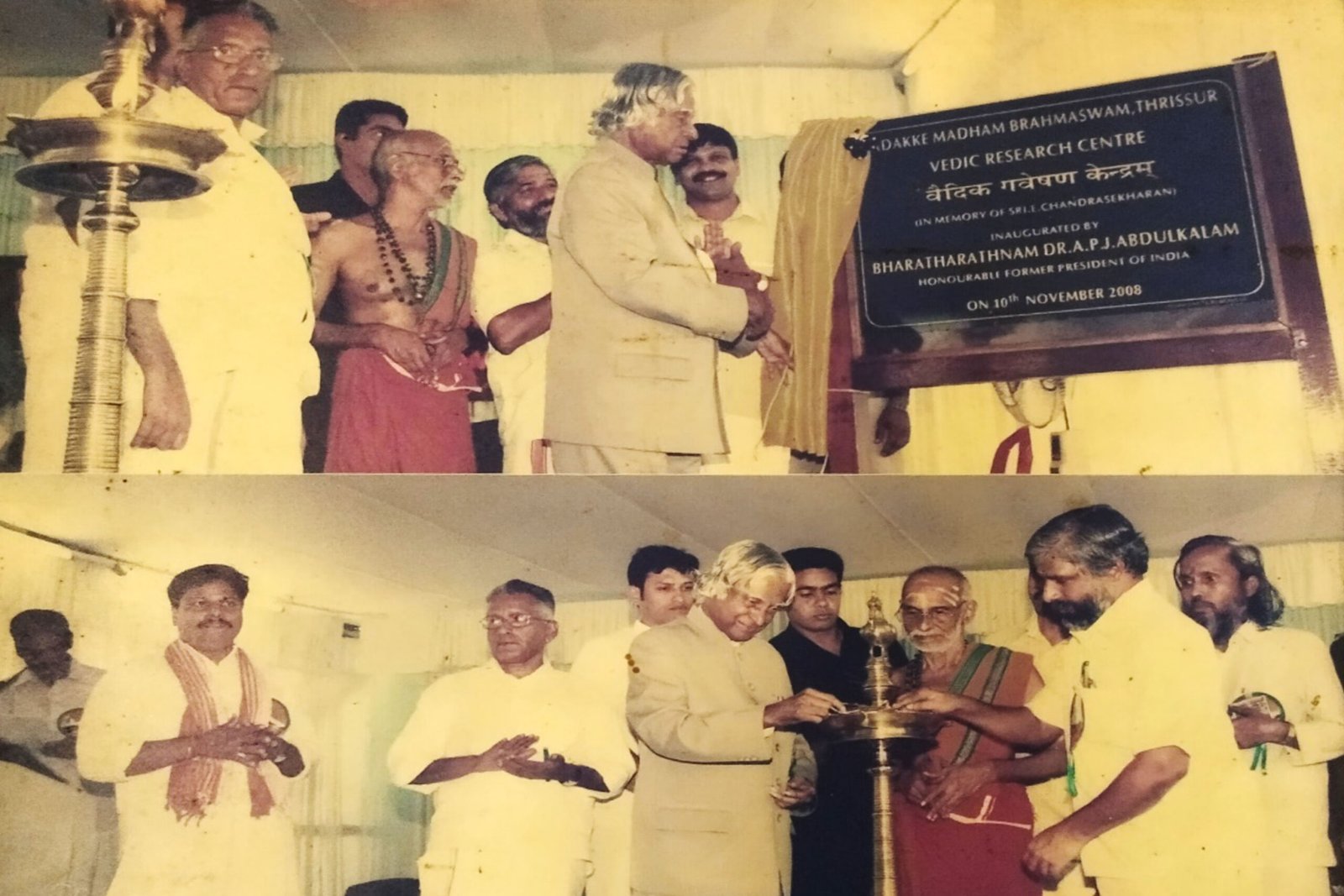
During the meetings in Delhi chaired by K. Jayakumar, one major difficulty faced for allotting the financial assistance was that most of the ancient traditional institutions had no registration according to the Society/ Trust Registration Act. The institutions had a history of many centuries not having any such registration formalities. Presently, Govt. funds or financial assistance can be allotted to the institutions that have completed such registration formalities only. In the case of VMB, as mentioned earlier, we have a deed transferring the administration of the Madham to the Rigveda Namboothiris of Kerala which is in 1908. Society registration act etc. became fully in vogue after 1950s. Most of the the traditional institutions were not thus qualified to receive the financial assistance. Sri K. Jayakumar was kind enough not to consider such formalities for giving financial assistance to the traditions recognised by UNESCO in the first stage of its distribution. But he cautioned that Society / Trust registration should be secured by all such institutions to enjoy financial assistance in the future as it is a mandatory clause. This is how VRC was registered as part of VMB in 2008. As per the bylaws of VRC, it will concentrate more in the dissemination Vedic knowledge in the right spirit conducting national/ international level workshops and seminars, documenting Vedic and allied traditions that are in the stage of extinction, publishing unpublished and rare works in the area and the like. Imparting traditional Vedic chanting, which was confined to a section of Brahmanas only till very recently, to all those who are interested irrespective of caste, creed or gender, was another major activity that VRC decided to undertake which is continuing successfully now in VMB. Thus the establishment of VRC helped to open a new phase of development in the history of Vedic tradition. I was the founder secretary of VRC and after continuing in the post for many years, I am now working as the Chairman of VRC in VMB. VRC has conducted / is conducting so many seminars and workshops and has carried out / is carrying out some projects for documenting rare and vanishing Vedic traditions of Kerala. For all these, VRC is availing financial assistance from various Govt. / Semi Govt, agencies like IGNCA, Delhi; NMM; MSRVVP, Ujjain; ICPR, Delhi: ICHR, Delhi; South Zone Cultural Centre, Tanjvur and the like. VRC has brought out two publications also in the related areas.
Pandit Subbaramapattar Endowment
VRC has been able to institute some prestigious endowments in the name of great scholars and men of literature. Required amount of money will be deposited in VRC in their names by their family members or disciples, the interest of which will be utilised every year for organising memorial lectures, presentation of awards and such other activities as per the memorandum of understanding signed between VRC and the concerned party. One such prestigious endowment is Pandit Subbarampattar endowment instituted in VRC.
Subbaramapattar was a great Sanskrit scholar and author of many books in Sanskrit and Malayalam. He was living in Thrissur with his wife, the couples having no children. Subbaramapattar had a number of devoted disciples all over Kerala and other places. Subbaramapatter, after reaching his abode in the heaven, wife Narayani Ammal became alone, they having no children. Sri.P.V.Raman, settled in Mumbai, was the youngest brother of Narayani Ammal. Sri. R. Venkatakrishnan, son of P.V. Raman, who is working in high position in Mumbai, as directed by his father, took Narayani Ammal, wife of Subbaramapattar to Mumbai and protected her who also died after some years.
When Narayani Ammal was shifted to Mumbai, the property of Subbaramapattar and his wife in Thrissur was disposed. Though it was a small house with limited land area, as it is in Thrissur city, it could be sold for lacks of rupees. Venketakrishnan and other family members unanimously decided to devote the whole amount for instituting various endowments in the academic institutions where Subbaranapattar was attached in one way or other, instead of dividing the money among themselves. This was, needless to state, a strong decision which usually no one will dare to take. Actually, this is a pious Pranam to the great knowledge tradition, for which Subbaramapattar devoted his full life. Sri. Venkitakrishnan and the family members should be appreciated and congratulated for taking such a strong decision.
Sri. Krishna Iyer of Nadavarambu at Irinjalakkuda, near Thrissur, is the son of the sister of Narayani Ammal, wife of Subbaramapattar who is the owner of the prestigious bell-metal factory there. Years ago, when I was organising a national seminar on Veda at Irinjalakkuda utilizing the financial assistance of Ministry of Culture, Govt. of India mentioned earlier, allotted to Kanchi Kamakodi Yajurvedapadhasala Irinjalakkuda, I happened to meet Krishna Iyer through Mr. Thankappan, then Devaswam Board President of Kudalmanikkam Temple, Irinjalakkuda, who was the chief of the organising committee of the seminar. It is thus I came to know about the fund and their willingness to donate the same to such endowments. Immediately I contacted Mr. Venkitakrishnan at Mumbai and things moved smoothly with the co-operation of all connected. Rupees fifteen lakhs was donated by Venkitakrishnan for the family of Subbaramapattar for the endowment in the name of the great scholar at VRC, VMB. The endowment activities with the interest of the amount every year, include one day Vakyarthasadas and an award of twenty five thousand rupees for a reputed Sanskrit scholar in the name of Subbaramapattar. This is the biggest endowment received by VRC till the date. VRC is extremely thankful to Sri. Venkitakrishnan and the family members for instituting such a prestigious endowment in VRC.
Sri. Venkitakrishnan and the members of the family of Subbarama Pattar were kind enough to institute such prestigious endowments in other academic institutions also in Kerala where they deposited lakhs of rupees for the purpose which are the following, all yearly with the interest of the amount deposited.
- Sree Sankaracharya University of Sanskrit, Kalady. Rs. Six lakhs, instituted in 2009, for giving awards to the best student in the PG classes of Sanskrit disciplines, Sahitya, Vyakarana, Nyaya, Vedanta, General and Vedic studies in the name of the scholar.
- of Sanskrit, University of Calicut, rupees ten lakhs in 2017 for organising international endowment lecture in the name of Subbaramapattar and for providing ‘Pandit Subbaramapattar cash award’ to the best outgoing PG student
- Sree Sankaracharya University of Sanskrit, Kalady in 2017 for conducting conference on ‘New Horizons of Indological Studies’ every year, rupees fifteen lakhs.
- Sree Kerala Varma College, Thrissur in 2018, rupees five lakhs to distribute Pandit Subbaramapattar Endowment Award to top students of BA and MA of the college and for conducting Subbaramapattar memorial inter-school competitions every year.
This shows the enthusiasm and dedication of Sri. Venketakrishnan and the family members of Subbaramapattar to dedicate such huge amount in the institutions for the propagation of Sanskrit. The endowment in VRC, VMB was started in 2017 where Subbarama pattar has served as Sanskrit teacher. In Kerala Varna college also, he has worked as Sanskrit teacher for some time.
Other endowments in VRC, VMB
Like that of Pandit Subbaramapattar, there are other endowments also instituted in VRC in the name of great scholars and celebrated personalities by their family members and friends. The amount of endowments deposited is one lakh and above.
- Andaladi Vasudevan Namboothirippad endowment for organising one day Vakyarthasadas every year in his name. Andaladi Vasudevan Namboothirippad, belonging to the famous Tantri family, Andaladi Mana, Maruthur, Pattambi, has served as the President of VMB years before.
- Erkara Raman Namboothiri Endowment for organising endowment lecture in his name. Erkara was a celebrated Veda-Srauta scholar and the author of some books related to the area.
- Srikanthakumaraswami – Jayalakshmi endowment for organising endowment lecture every year in their name. Srikanthakumaraswami was a great Yajurveda scholar from Karnataka. After his traditional education in Veda, he acquired modem education in engineering and became professor in Madras IIT. Jayalakshmi was his wife. The endowment was instituted by their daughter Dr. Suma Damodaran.
- Kunhan Raja endowment for organising endowment lecture every year in his name. Dr. Kunhan Raja was a great scholar in Sanskrit and Veda from Kerala and author of many books who was internationally recognised in the field. The endowment was instituted by his family member Justice C.S. Rajan.
- Akavoor Narayanan Namboothiripad endowment for conducting endowment lecture every year in his name and to distribute scholarships to the bright students in Veda in VMB. The endowment was instituted by his sons and family members.
- T. Aryadevi endowment for presenting award for a scholar in Sanskrit / Veda every year. Dr. T. Aryadevi was a great scholar in all Sastras in Sanskrit, particularly Nyaya. She was working in Sree Sankaracharya University of Sanskrit, Kalady and retired as Professor and Dean of Nyaya from there. The endowment was instituted by her family members.
All these endowment lectures, Vakyarthasadas and award presentation ceremonies are conducted in a grand manner by VRC every year. Recently, some lecture series are conducted as outreach programmes in collaboration with reputed academic centres like Kerala Kalamandalam Deemed University, Malayalam Sarvakalasala, Thirur, Malappuram Dist and in reputed colleges where PG and research programmes are conducted. This gives new academic dimensions and acceptance to the programmes organised by VRC.
International project for preserving, cataloging and digitizing of the manuscripts of South Indian states
For the past more than five years, the international project for preserving, cataloging and digitizing the manuscripts of South Indian states is being carried out by VMB and VRC jointly. The project is going on in collaboration with EFEO, Pondichery. First project in this regard was successfully completed during 2018-2023. It was financed by British Library, London through EFEO, Pondichery. As part of the project about eight hundred bundles of manuscripts of the three Madhams of Thrissur (Vadakke Madham, Tekke Madham and Naduvil Madham) were preserved, catalogued and digitized. The whole matter is available in the online platform for researchers.
The project is continuing in VMB for another five years, 2023-2027. As part of this project, wherever manuscript depositories are there, that will be surveyed, located, if possible collected and preservation, cataloging and digitization will be carried out. Those owners who are not willing to donate their collection to the project in VMB will be contacted and their collection will be preserved, catalogued and digitized and returned based on a memorandum of understanding signed by the owner and the project team. The ongoing project is named DIPIKA (Digitization and Preservation of the Kerala Archives). It is funded by Arcadia and VMB, VRC, Thrissur; EFEO, Paris /Pondichery; Centre for the Study of Manuscript Cultures (CSMC), University of Hamburg, Germany; Hill Museum and Manuscript Library (HMML), Collegeville, USA are partners. The Arcadia Fund is a UK charity organisation founded by Lisbet Rausing and Peter Baldwin. Anna Lisbet Kristina Rausing, born in 1960, is a science historian and philanthropist. She is a co-founder of Arcadia, one of UK’s largest philanthropic foundations. Peter Baldwin, born 1956, is a research professor of History at the University of California, Los Angeles, Global Distinguished Professor at New York University and a philanthropist. Arcadia Foundation, established in 2001 provides grants in a worldwide basis focusing on numerous projects outside the UK. The primary focus of the organisation is to preserve endangered culture and nature and to provide open access to them. The organisation believes that ‘once memories, knowledge, skills, variety and intricacy disappear- once the old complexities are lost – they are hard to replicate or replace and consequently want to ‘build a vibrant, resilient, green future’. The funding is chanelised through EFEO Pondichery. Dr. Hugo David, EFEO, Paris is leading the project. He took great effort to prepare the DIPIKA project and submit it to Arcadia. He also skillfully co-ordinated the partners of the project. Dr. SAS Sarma from Kerala who is now working as senior researcher at EFEO, Pondichery, is an internationally known scholar proficient in Sanskrit and Indological research. He is co-ordinating VMB-VRC and other institutions mentioned for carrying out the project. Dr. Hugo David (EFEO, Paris) and Prof. Eva wilden (University of Hamburg) are the Principal investigators and Dr. Olga Nowicka, attached to EFEO and Hamburg University is working as the Co-ordinator of the Project at VMB, VRC. At present, Dr. M.V. Muraleekrishnan is working as the curator and Dr. Ushus K Unnikrishnan, Dr. Sreeja M.S, and Dr. Sudhanjali P.S are working as Research Scholars. Rinni K Jayan and E.S. Vishnu are working as Photographers. I am at present member of the administrative body of VMB and Chairman of VRC and also working as Academic supervisor in the project. Dr. S.A.S. Sarma, Senior Researcher, EFEO, Pondichery who is Co-ordinating the project with all sincerity and dedication, is also with us in the capacity of Academic Supervisor. The project is going on well which will continue till 2027. It is hoped the Project will continue still further with more funding of the type. Apart from the Co-ordinators, Research scholars and cameramen in full time basis, those in part-time basis for survey of manuscripts are also working in the project now.
***
(Prepared By Dr. C.M. Neelakandhan)
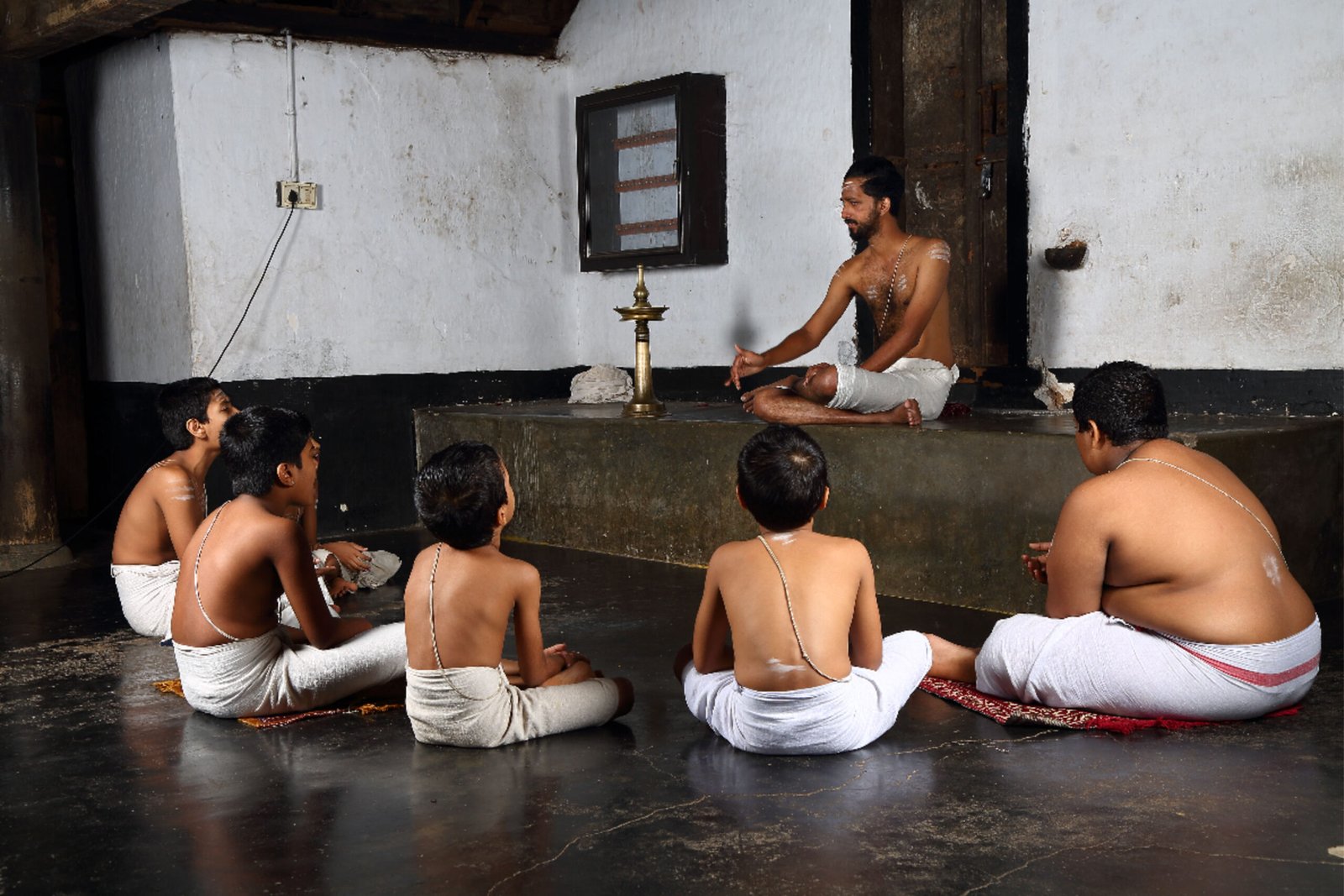
Students Studying Veda chanting from Guru in Brahmaswam Madham
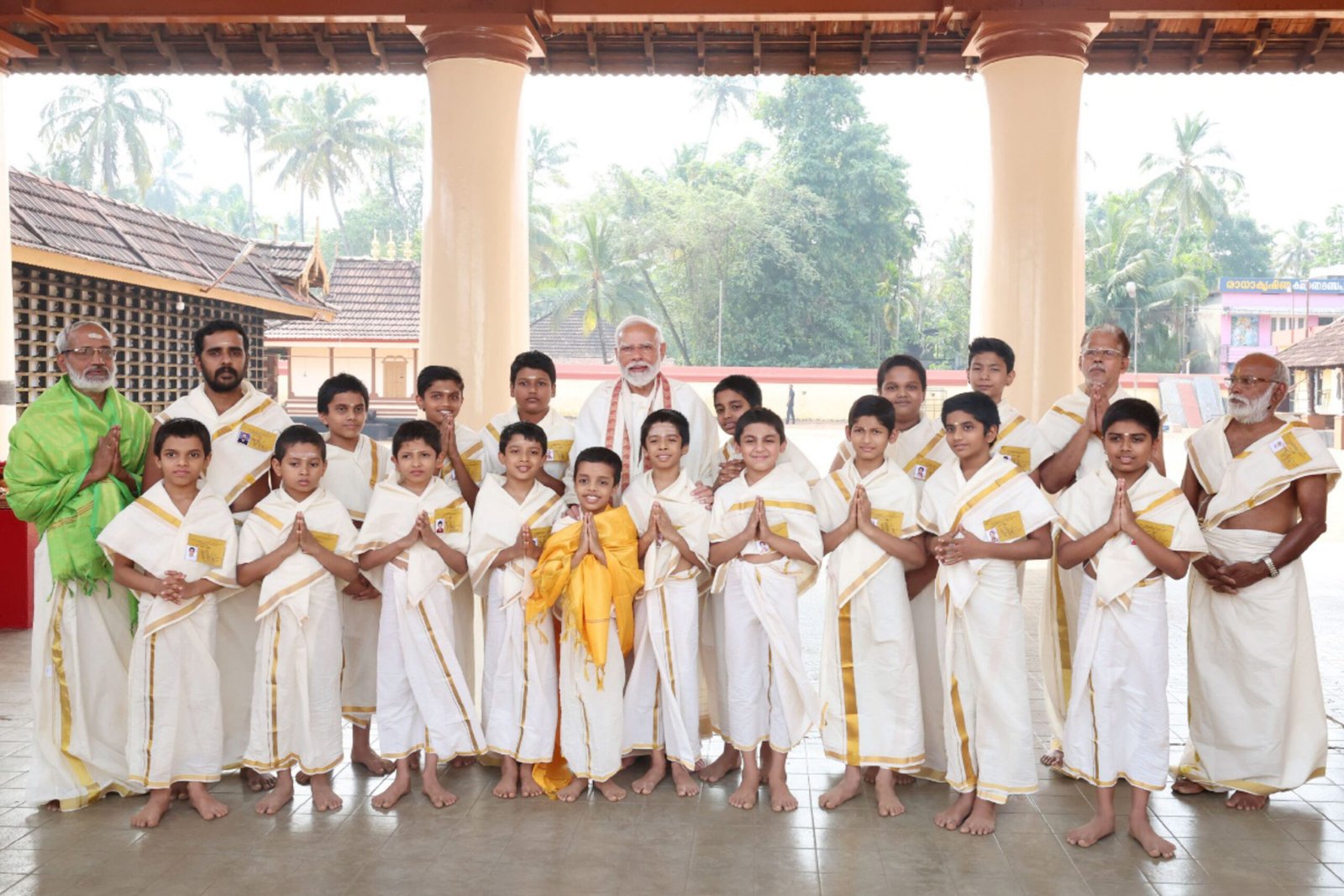
Vedic Students of Brahmaswam Madham, Thrissur with Hon’ble Prime Minister Narendra Modi
Former President of India, Dr.A.P.J Abdul Kalam inaugurating Vedic Research Centre at Brahmaswam Madham, Thrissur
Brahmaswam Madham, Thrissur